Visual Novel work progress
Published on: August 19, 2026
Here's a shot of ThorVG, Spine, and Live2D rendering in the visual novel client on Windows on a s8060s ROG Flow Z13, under a millisecond.
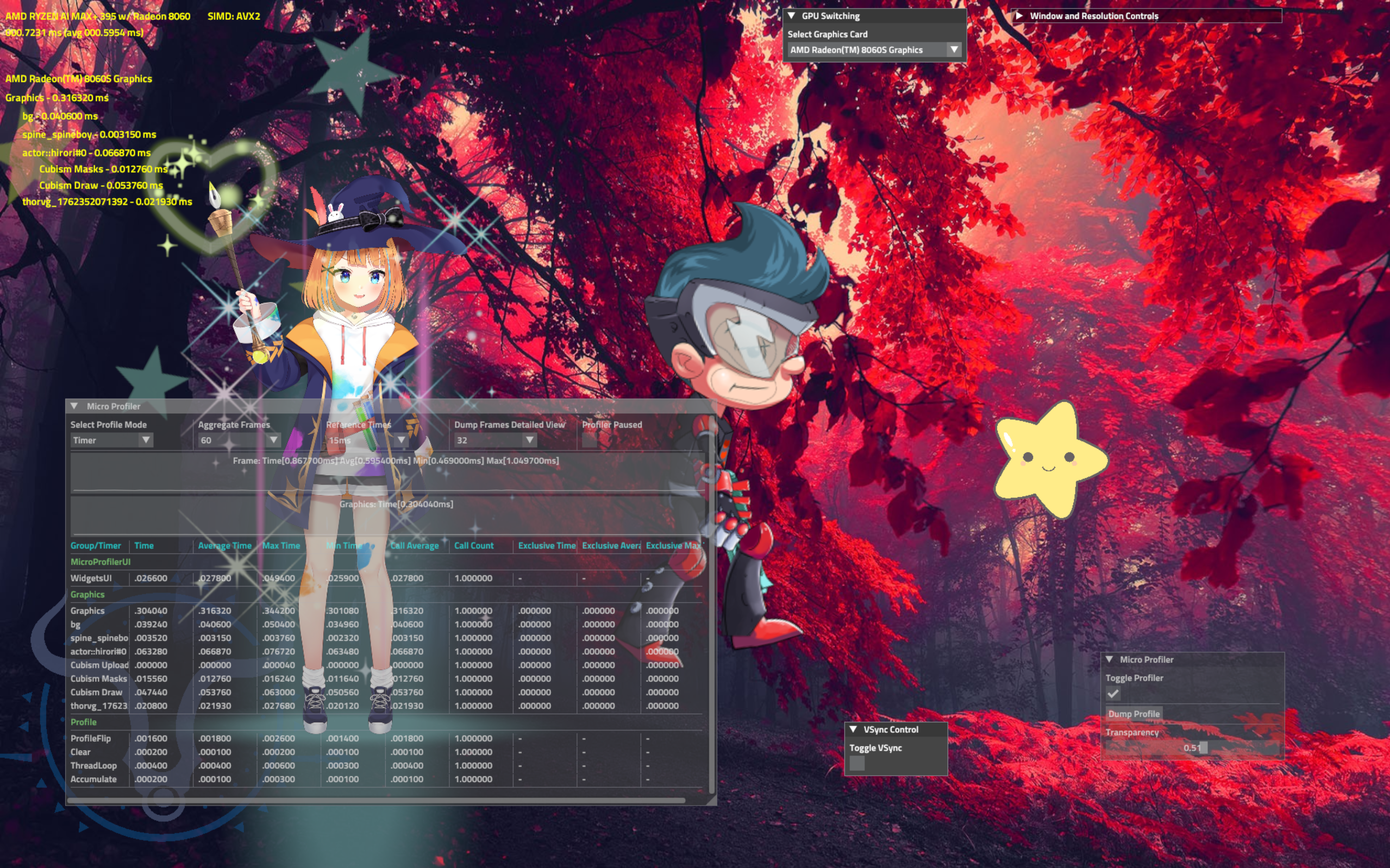
It's taken us some time to finish the design and implementation of the visual novel plan.
Using the same approach we took to interactive fiction and MUDs, we over-engineered everything, causing both pain and joy, mostly pain.
Instead of going the route of using basic renderer approaches like Sokol, SDL, or bgfx, and focusing on static images, which, to be honest, was the original plan, we reached deep down and pulled in a renderer we've had some experience with: Confetti FX's The Forge. It has been used on everything from titles like Hades and Hades II to Starfield. It's proven, it's solid, and most importantly, it's multi-platform, including consoles.
Some time ago, Bradley was in the process of updating Signal Studios' SigEngine to use The Forge, and during Outer Heaven's Ascend PC port/re-release he made architectural plans for integrating The Forge into SigEngine in anticipation of a sequel, but, as a lot of things go sometimes in games, it never came to pass.
The planning, however, was not wasted. Instead of SigEngine, we put it in mythoi, because why not? We would have had to write a ton of shaders no matter what we used.
What this means for mythoi's visual novel support: you get it all.
We've written rendering backends for Live2D, Spine, ThorVG, Lottie, and more are coming. You will be able to use ThorVG for UI, granting vector-based, resolution-independent UI with interactivity and apollo support, resulting in a UI solution surpassing the old Flash-based stuff that was all the rage. Scaleform GFx kind of went away/vanished, and it cost too much anyway, and Flash sucks, but none of that matters because we made a better version of the same concept: a scriptable, resolution-independent UI system with documentation that doesn't read like a master's thesis had a baby with a spreadsheet.
Not stopping there, as mentioned, in order to give artists and designers as many tools as possible (and because we hate writing editors), we will offer both Spine and Live2D support as optional modules. They will be available as DLC so mythoi users aren't wedged into using middleware they don't want or need. ThorVG/Lottie, however, will be built into the engine.
This means that mythoi now implicitly kind of pokes into the game engine arena, though we won't be pushing that until after visual novels and interactive fiction/MUDs are nailed down. Choo Choo.
For visual novels, we also designed and developed an advanced dialogue system that's easy to use and full of analytic tools for testing and dead-path detection. We'll make a blog post about it. We even wrote a tool. We took a node-based/graph approach to the internals and made it as easy to populate as traditional methods.
Oh yeah, we almost forgot to mention. The new apollo compiler frontend is in, where we've added support for language keywords in Japanese/Kanji, with more languages coming soon. This means you can write apollo, and get error messages, in something other than English. You can do things like that when you own the language, the toolchain and the runtime. Which is why we wrote the language, the toolchain, and the runtime.